
August 2, 2026 · By David
The Exposure Triangle Myth: What ISO Actually Does
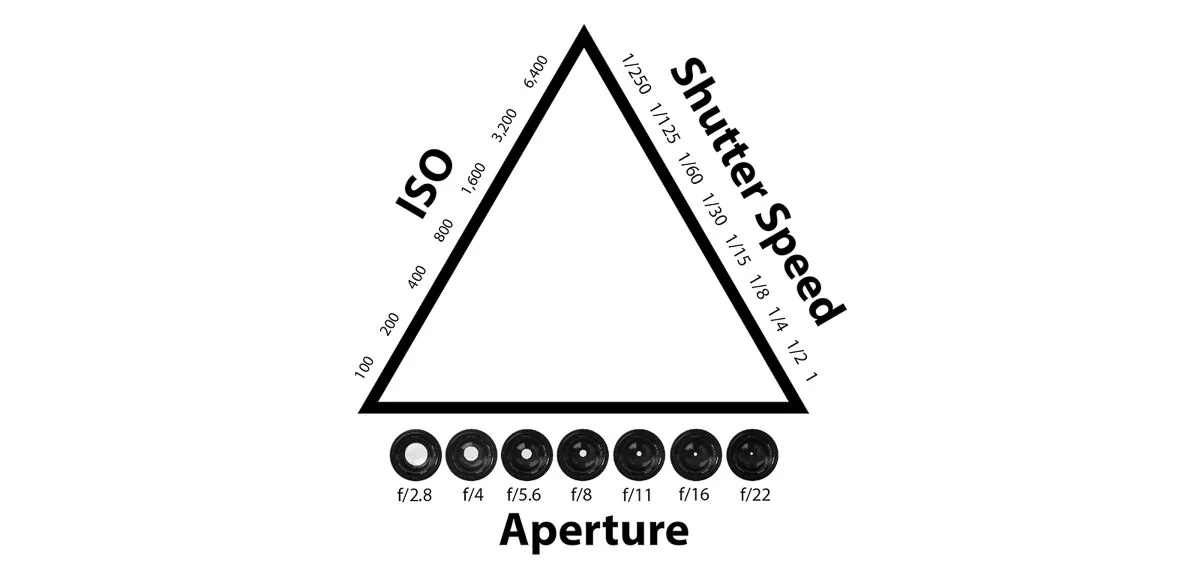
Every photography course starts the same way. Aperture, shutter speed, ISO, drawn as a neat triangle with exposure sitting in the middle like the prize for balancing all three legs correctly. It’s a good teaching tool. It’s also not quite true, and once you notice the crack in it, you start making better decisions in the field.
Here’s the crack: aperture and shutter speed control exposure. ISO doesn’t.
What exposure actually means
Exposure is the amount of light that lands on your sensor, full stop. Photographers measure it in EV1, and the formula for EV only has two variables in it: aperture (the size of the opening letting light through) and shutter speed (how long that opening stays open). Multiply the two together and you get a quantity of light. That’s exposure. ISO is nowhere in that equation, because ISO doesn’t touch the light at all.
What ISO actually does is take the light that already hit the sensor and amplify the resulting signal, either through analog gain in the sensor’s readout circuitry or through digital scaling afterward, depending on the camera and the ISO value in question. Either way, the photons were already captured before ISO ever gets involved. Cranking your ISO from 400 to 1600 doesn’t let more light in. It just tells the camera to make the recorded signal brighter.
What each control is actually for
It helps to think about what the three settings do to your photo, not just to your exposure meter.
Aperture controls depth of field. A wide aperture like f/1.8 gives you that thin slice of focus with a blurred background, and a narrow one like f/11 keeps a whole landscape or a real estate interior sharp front to back. That’s a creative decision as much as a technical one.
Shutter speed controls motion. A fast shutter freezes a moving subject, a slow one blurs it, whether that’s water turning silky in a long exposure or a drone shot smearing slightly because you dropped below a safe speed for the wind. Again, a creative choice.
ISO does neither of those things. It only makes the recorded image brighter or darker after the fact. It has no effect on depth of field, no effect on motion, and as covered above, no real effect on exposure either. Of the three legs of the triangle, ISO is the only one that isn’t actually needed to expose a photo. Aperture and shutter speed are the two settings doing real optical work. ISO is bookkeeping.
Set aperture and shutter first, leave ISO on auto
Once that clicks, the order you set things in should flip. Decide your depth of field, decide how you want motion to look, and set aperture and shutter speed for those reasons first. Then let auto ISO handle the brightness. The camera’s metering is generally good at this, and since ISO isn’t doing anything to the actual exposure, there’s rarely a reason to fight it.
There are a handful of situations where manual ISO earns its place: locking exposure across a sequence of frames for a panorama or timelapse where you need every frame to match exactly, working with flash where auto ISO can fight against your flash exposure, or shooting long exposures at night where you want to sit at base ISO on purpose to protect dynamic range. Outside of cases like that, auto ISO with manual or aperture/shutter priority control gets you to the same result with one less thing to think about mid-shoot.
Where the triangle still earns its keep
None of this means ISO doesn’t matter day to day. It changes your histogram, your in-camera preview, and your autofocus behavior in low light, which matters when you’re chimping shots on a shoot with a client standing next to you. On a sensor that isn’t fully ISO invariant2, getting the brightness closer to right in camera can still produce a cleaner file than a heavy push in post.
I still teach the triangle to people starting out, because as a mental model for balancing settings against each other, it works. The problem isn’t the triangle as a teaching device. The problem is treating all three legs as if they’re doing the same job. Aperture and shutter speed are gathering light and shaping the image. ISO is deciding how loud to play back what was already gathered.
Footnotes
-
EV, or exposure value, is a number representing a specific combination of aperture and shutter speed that lets in a given amount of light. It’s the standard unit photographers and light meters use to talk about exposure independent of ISO. ↩
-
A sensor is described as ISO invariant when raising ISO in-camera and raising exposure by the same amount afterward in post-processing produce roughly the same image noise. It’s a spectrum rather than a strict yes-or-no, and it varies by camera model and manufacturer. ↩